








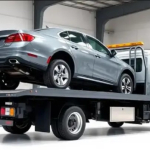
High-density urban neighbourhoods featuring multi-family complexes and shared rear laneways rely on clear, unobstructed access routes to maintain baseline public safety. These narrow arterial pathways are specifically designed to accommodate municipal services, heavy delivery vehicles, and most importantly, massive emergency response equipment. When a property owner decides to store a non-running, broken car in a shared alleyway or a tight rear parking bay, they are not merely making a poor aesthetic choice for their own home. They are actively creating a physical barrier that can have catastrophic consequences during a neighborhood crisis, directly challenging the conventional assumption that private property storage has no external impact on the surrounding community.
Emergency response vehicles, particularly modern fire engines and heavy bariatric ambulances, require substantial physical clearance to steer safely through narrow urban corridors. These vehicles are significantly wider, taller, and longer than standard passenger cars, demanding clear corner radiuses to turn effectively without causing property damage. A stationary vehicle parked awkwardly at the edge of a shared alleyway reduces this available clearance by critical inches. During a structure fire or a sudden medical emergency, a fire truck can become physically wedged against the obstruction, forcing first responders to abandon their vehicle and carry heavy rescue gear on foot over long distances, wasting irreplaceable seconds when a life hangs in the balance.
The physical obstruction becomes even more severe during the freezing winter months when heavy snow accumulation naturally narrows the usable width of city laneways. A stationary car catches drifting snow, creating large, icy mounds that municipal ploughs cannot clear without risking severe damage to the abandoned vehicle. This leaves the alleyway completely impassable for heavy emergency apparatus. If a resident suffers a sudden health crisis in a rear apartment block, paramedics cannot bring their stretcher to the door. The presence of a single neglected car effectively isolates multiple homes from the municipal safety network, shifting the burden of neglect onto innocent neighbours who rely on that access.
Furthermore, these tight urban laneways often house critical municipal utilities, including high-voltage electrical transformers, underground gas meters, and primary fire hydrants. Parking a dead vehicle over or adjacent to these utility access points prevents maintenance crews from conducting urgent repairs during a neighborhood blackout or a dangerous gas leak. In a worst-case scenario, firefighters might arrive at a blaze to find a vital hydrant completely obscured or blocked by a rusting chassis, forcing them to run much longer hose lines from the main street. This delay allows a localized fire to grow exponentially, threatening adjacent wooden balconies and shared roof structures in high-density residential zones.
Civil responsibility demands that urban residents maintain their properties in a manner that does not compromise collective neighborhood safety. Storing an immobile piece of scrap metal in a shared access zone is an completely unacceptable public risk. Homeowners must recognise that when a vehicle stops being an active mode of transport, it immediately becomes a spatial liability. Arranging for a professional Scrap Car Removal Montreal service is the only responsible method to clear the lane entirely, ensuring that municipal safety vehicles retain full, unrestricted access to every home on the block at a moment's notice.
The extraction process is handled by commercial operators who specialise in safely navigating tight urban spaces, pulling the dead car away cleanly without disrupting the neighbourhood or damaging adjacent fences. Clearing the alleyway restores the underlying safety infrastructure of the community, ensuring that first responders can perform their duties without delay. True civic pride means keeping shared pathways clear, protecting your neighbours, and recognizing that an empty lane is a safe lane for everyone.
Conclusion
Storing an immobile vehicle in high-density laneways restricts emergency vehicle clearance and creates dangerous physical blockages during winter weather. Removing the dead machine immediately restores essential access routes, protects surrounding multi-family homes, and ensures that first responders can reach your community without life-threatening delays.
Call to Action
Protect your local community and clear critical emergency access routes by scheduling a swift, professional vehicle removal today.
